Don't miss our holiday offer - up to 50% OFF!


Gas vs Battery-Powered Remote Control Lawn Mowers: Complete Comparison

gas vs battery remote control lawn mowers is one of the most important factors. gas vs battery remote control lawn mowers is one of the most important factors to consider. gas vs battery powered remote control lawn mowers is an important decision. One of the most common questions we hear from buyers is whether to choose a gas vs battery remote control lawn mower. Both have their strengths, and the right choice depends on your workload, budget, and environmental priorities. Let’s compare them side by side so you can make an informed decision.
Choosing the right equipment saves you time, money, and frustration. This guide walks you through everything you need to know.
Gas vs Battery Remote Control Lawn Mowers: Which Is Right for You?
Gas engines have been the standard in outdoor power equipment for decades. A gas-powered remote control mower typically uses a 170cc to 196cc four-stroke engine that delivers consistent torque for cutting thick grass, brush, and weeds on challenging terrain. The gas engine’s reliable torque curve is especially valuable on steep slopes where the mower needs sustained power to climb while cutting.
Pros:
- Unlimited runtime—just refuel and keep working
- Strong torque for heavy cutting and steep slopes
- Fuel widely available at any gas station
- Mature technology with easy maintenance and repairs
- Higher resale value and proven durability
Cons:
- Louder operation
- Emissions and oil changes required
- More vibration and routine maintenance
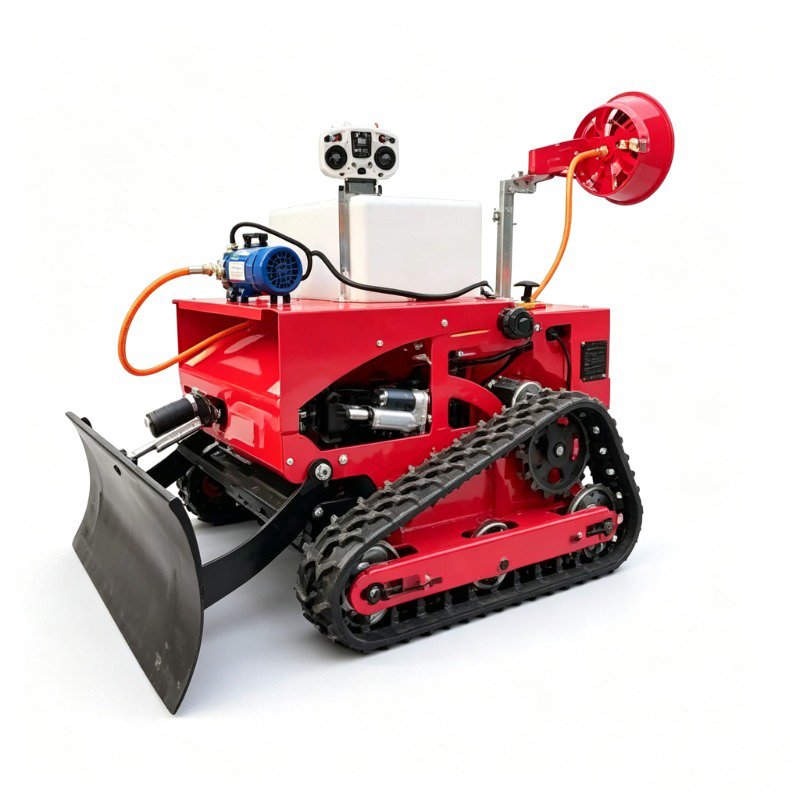
Our X550 gas-powered remote control mower and 800mm wide-deck model use reliable gas engines that handle commercial workloads with ease. For larger properties, our 1000mm tracked mower pairs the gas engine with tracks for maximum slope capability.
Battery-Powered Remote Control Mowers
Battery electric remote control mowers are a newer option that has gained traction in recent years. They use lithium-ion batteries to drive electric motors, offering quieter operation and zero on-site emissions. The instant torque delivery of electric motors means the blades spin up quickly, and there’s no engine warm-up period needed.
Pros:
- Quiet operation—ideal for residential areas and early-morning mowing
- Zero emissions at point of use
- Instant start with no pull cord or choke
- Minimal maintenance (no oil changes, spark plugs, or air filters)
- Simpler mechanical design with fewer moving parts
Cons:
- Limited runtime per charge (typically 1–2 hours)
- Requires spare batteries and charging downtime
- Less torque for very thick brush
- Higher upfront battery cost
Which Is Right for You?
Choose gas power if you have large acreage, thick vegetation, steep slopes, or commercial workloads where downtime is costly. Gas mowers are also the better choice if you need to work continuously for hours without charging breaks. Our large yard buying guide explains why gas remains the preferred choice for big properties.
Choose battery power if you have a smaller lawn, noise restrictions, or environmental concerns. Battery mowers are also easier to maintain and operate. For more on how remote mowers compare to traditional equipment, see our push mower comparison and our guide on battery mowers vs slope mowers.
Cost of Ownership
While battery mowers have higher upfront costs, they save money on fuel and maintenance over time. Gas mowers require oil changes, air filter replacements, spark plugs, and annual tune-ups. Battery mowers need none of these. However, battery replacement every 3–5 years can be a significant expense that offsets some of those savings. When comparing gas vs battery remote control lawn mowers, be sure to calculate the 5-year total cost including fuel or electricity, maintenance, and battery replacement.
Final Verdict
For most homeowners and commercial operators in the US and Canada, a gas-powered remote control mower remains the most practical choice—especially for hilly or rough terrain. Browse our full product range or contact us for personalized recommendations based on your property size and terrain.
For official emissions standards, see the EPA small engine regulations.

[…] choice. For small residential lawns or noise-sensitive neighborhoods, battery is now viable. Our gas vs battery comparison covers this in […]