Don't miss our holiday offer - up to 50% OFF!


Robot Mower vs Remote Control Mower: 7 Proven Differences for Hills in 2026

If you are weighing a robot mower vs remote control mower for a hilly property, you are asking the right question at the right time. Both machines mow without an operator on board, but they are fundamentally different tools. A robot mower is an autonomous robot that trims a boundary-defined lawn by itself, day after day. A remote control mower is a powerful slope machine you drive with a transmitter, built for banks, orchards, and rough terrain that robots and riders cannot handle. This 2026 guide compares the robot mower vs remote control mower decision with market data, safety statistics, price benchmarks, and real slope-testing experience — so you can choose the machine that actually fits your land.
Robot Mower vs Remote Control Mower: The Market Reality in 2026
The broader market explains why both categories are booming. The robotic lawn mower market reached USD 9.3 billion in 2025 and is forecast to grow to USD 22.0 billion by 2033 (CAGR 11.4%), according to Grand View Research. The remote lawn mower segment tracked by PW Consulting is projected to grow from USD 2.02 billion in 2025 to USD 3.70 billion by 2032 (CAGR 9.01%).
Both forecasts point the same direction: operators are leaving riding machines behind. But the two products serve different buyers. Robot mowers sell to suburban homeowners with flat, fenced lawns. Remote control mowers sell to property owners, farmers, and landscapers with slopes, ditches, orchards, and rough ground. The robot mower vs remote control mower question is really a terrain question.
Bar chart: market size projections (USD billion)
Robotic 2025 $9.3B
Robotic 2033 $22.0B
Remote 2025 $2.02B
Remote 2032 $3.7B
Sources: Grand View Research (robotic), PW Consulting (remote). Bar widths are proportional to projected market size.
What Is a Robot Mower? How It Works
A robot mower is an autonomous battery-powered robot that cuts a defined perimeter automatically. You bury a boundary wire (or use GPS mapping on newer models), set the schedule, and the robot returns to its charging station on its own.
Key Characteristics of Robot Mowers
- Autonomous operation: no joystick, no operator — the robot navigates and cuts by itself.
- Small cutting decks: typically 9-14 inches wide; they mow continuously to keep grass short.
- Slow but steady: most robots mow 0.05-0.5 acres per hour (per Inch Calculator), so they run for hours every day.
- Low deck, light weight: usually 15-35 kg, designed for manicured turf.
- Battery powered: silent, emission-free, with charging docks.
Where Robot Mowers Excel
- Flat, fenced suburban lawns up to about 1 acre.
- Owners who want “set and forget” trimming.
- Neighborhoods where daily quiet operation is a bonus.
Where Robot Mowers Struggle
- Slopes: most robots are rated for 15-25 degrees at best, and they slip on wet grass.
- Rough terrain: bumpy ground, weeds, and debris stall small robots.
- Large acreage: a 2-acre lawn takes most robots 2-4 days of run time per cut.
- Obstacles: dense gardens, tree rings, and narrow gaps confuse boundary systems.
For the full picture of robot mower capability, see our review of top automatic robot mower models.

What Is a Remote Control Mower? How It Works
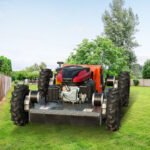
A remote control mower is a radio-controlled mowing machine with no rider and no autonomy. You hold a transmitter and drive the machine yourself — typically up to 80 meters away — steering it across slopes, ditches, and orchard rows at walking-to-moderate speed.
Key Characteristics of Remote Control Mowers
- Operator-driven: you are in control with a 2.4 GHz transmitter; no boundary wires, no GPS mapping.
- Large decks: 500-1000 mm (20-39 inches) — far wider than any robot.
- Real mowing power: gas, battery, or hybrid engines with commercial-grade blades.
- Slope capability: tracked models work to 35-45 degrees; wheeled models to 20-25 degrees.
- Built for rough ground: steel decks, high clearance, and optional rubber tracks.
Where Remote Control Mowers Excel
- Steep banks, roadside ditches, dam faces, and orchard rows.
- Properties of 0.5-10 acres with significant slope.
- Commercial crews that need throughput on rough terrain.
- Operators who want direct control over every pass.
Where Remote Control Mowers Are Less Ideal
- Tiny flat lawns where a robot or even a push mower is cheaper.
- Operators who want zero interaction — a robot wins on automation.
Read our complete remote control lawn mower buying guide for the full model-by-model breakdown.
Robot Mower vs Remote Control Mower: 7 Proven Differences
Here is the complete robot mower vs remote control mower comparison across the seven dimensions that decide the purchase.
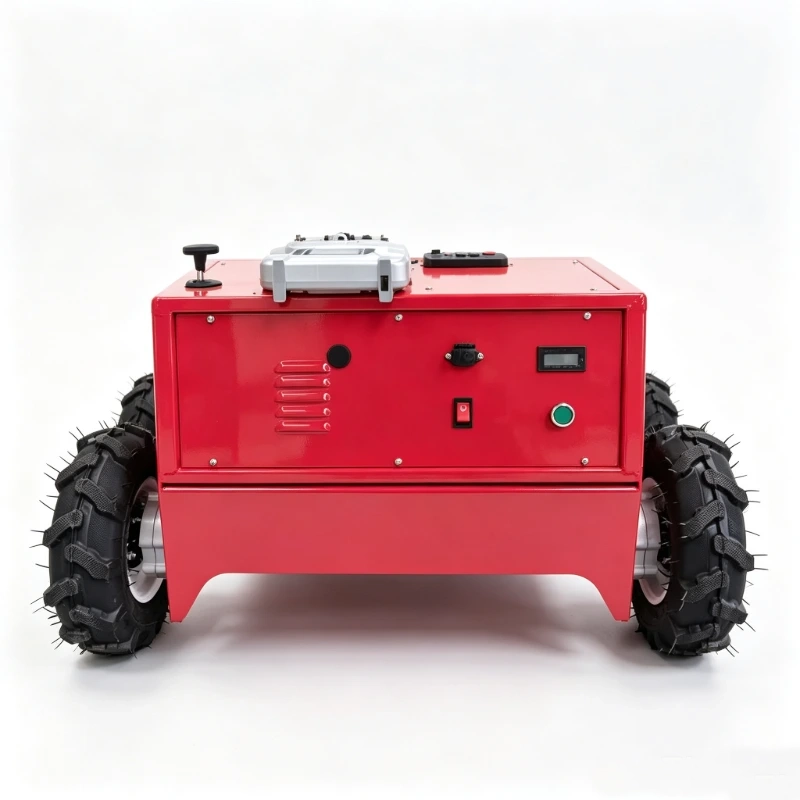
1. Slope Capability
This is the decisive difference. The U.S. Consumer Product Safety Commission (CPSC riding mower fact sheet) documents that riding mower incidents cause about 35,000 ER visits and roughly 90 deaths per year, and slope rollovers are the dominant fatal pattern. Robot mowers remove the rider but still lose traction on real banks: most are rated to 15-25 degrees, and wet grass stops them much earlier.
- Robot mower: 15-25 degree max slope (manufacturer-rated); slips on wet grass; boundary wires complicate sloped perimeters.
- Remote control mower: wheeled models to 20-25 degrees; tracked models to 35-45 degrees; grip improves on wet grass with rubber tracks.
If your property has any bank steeper than 20 degrees, the robot mower vs remote control mower debate ends right here: you need a remote mower. Our steep-slope buying guide explains the ratings in detail.
2. Price
Prices overlap more than buyers expect:
- Robot mowers: $800-$4,500 (entry robot to GPS-equipped premium).
- Remote control mowers: $2,000-$6,500 factory-direct (Xinfa); $8,000-$20,000+ European premium.
Bar chart: typical price ranges (USD)
Robot entry $0.8-2k
Robot premium $2.5-4.5k
RC Xinfa 500-550 $2-4.5k
RC Xinfa 800-1000 $4.5-6.5k
Euro remote $8-20k+
A factory-direct remote mower like Xinfa’s 550 mm wheeled model lands in the same price band as a premium robot — but adds real slope capability and 10x the deck width. See our cost breakdown for the full math.
3. Productivity and Mowing Speed
Robots mow continuously in small increments; remote mowers cut in dedicated passes. The numbers tell the story:
- Robot mower: 0.05-0.5 acres per hour; on a 1-acre lawn it runs 2-6 hours per cutting cycle.
- Remote control mower (550 mm): roughly 0.6-1.2 acres per hour on slopes.
- Remote control mower (800-1000 mm): 1.0-2.5 acres per hour — a full cut in one session, not a week-long schedule.
For a hilly 1-3 acre property, a remote mower finishes the job in one afternoon. A robot needs days of constant running — and on slopes, it may never finish at all. The Ariens productivity comparisons for rider machines show why throughput drives the commercial decision; remote mowers bring the same logic to slopes.
4. Terrain and Ground Capability
- Robot mower: manicured turf, flat, dry, obstacle-free lawns; boundary wire must follow the perimeter.
- Remote control mower: slopes, ditches, orchards, wet ground, tall grass, and brush; tracked models cross soft ground a robot would bog in.
If your land has any of these — banks, drainage ditches, orchard rows, uneven ground, or seasonal wetness — the robot mower vs remote control mower answer is unambiguous. Remote control mowers are built for the ground robots avoid.
5. Safety and Operator Risk
Both machines keep the operator off the deck — a huge safety gain over riding mowers. The differences:
- Robot mower: safe on flat lawns; but on slopes it can slip, stall, or wander into hazards; blade exposure near the ground is a pet/kid consideration.
- Remote control mower: you control it from up to 80 meters away; emergency stop on the transmitter; no boundary-wire failure mode.
The CPSC data above — 35,000 riding-mower ER visits and ~90 deaths per year — is why both categories exist. But only the remote mower extends that safety to real slopes. Our safety guide covers the details.
6. Maintenance and Operating Cost
- Robot mower: low maintenance (blade swaps, cleaning, battery care) but fragile electronics; boundary-wire repairs are a common headache; 5-year cost dominated by replacement parts.
- Remote control mower: standard small-engine or battery maintenance; steel decks and serviceable drivetrains last years; blades, belts, and filters are cheap and easy to replace.
Follow our remote mower maintenance checklist to maximize service life.
7. Control and Predictability
- Robot mower: you trust the algorithm. Great when it works, frustrating when it misses spots or gets stuck.
- Remote control mower: every pass is yours. You see exactly what was cut, where, and how well — which matters on banks and around trees.
For property owners who want reliable, observable results, direct control wins. This is why landscapers and municipalities choose remote mowers over robots for anything beyond flat lawns.
Robot Mower vs Remote Control Mower: Which Fits Your Property?
Use this decision framework to settle the robot mower vs remote control mower question for your own land in five minutes.
- Map the slopes. If any mowed area exceeds 20 degrees, skip robots entirely — you need a remote mower.
- Count usable acres. Under half an acre, flat and fenced: a robot is convenient. Over half an acre or any slope: remote control scales better.
- Check ground conditions. Wet spots, ditches, orchard rows, or rough ground → remote control, tracked if needed.
- Decide who operates. Want zero interaction? Robot. Want to control every pass and cut on demand? Remote.
- Set a budget. Above $2,000, the value comparison favors remote mowers because deck width and slope capability jump.
- Consider the fleet. Many owners run both: a robot for the flat front lawn, a remote mower for the hills behind the house.
Still unsure? Our ultimate buying guide and our large-yard durability guide walk through both scenarios in depth.
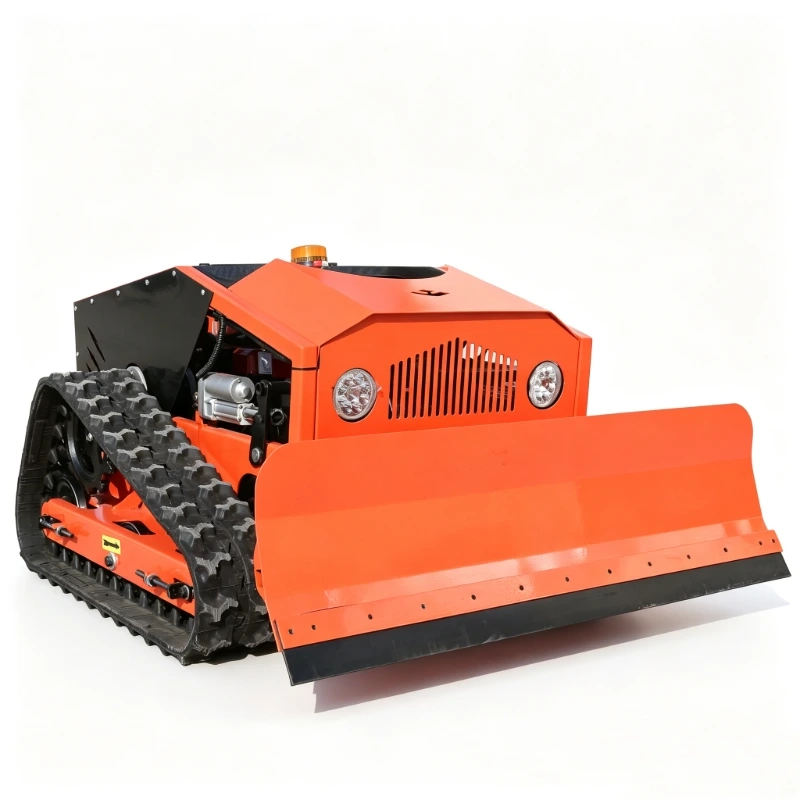
Why Xinfa Is the Smart Pick in the Robot vs Remote Decision
Once the robot mower vs remote control mower decision lands on the remote side, Xinfa is the brand to benchmark. Xinfa manufactures radio-controlled mowers factory-direct, which changes the economics in your favor:
- Factory-direct pricing: no dealer markup — typically 30-40% below comparable European remote mowers, and competitive with premium robots.
- Full lineup: 500 mm, 550 mm, 800 mm, and 1000 mm decks in wheeled and tracked configurations.
- 80-meter radio range: stand on safe ground while the machine works the hazard zone.
- Commercial build quality: steel decks, serviceable drivetrains, and documented spare parts.
- Gas, battery, and hybrid options: match the powertrain to your land and noise limits.
Popular Xinfa models to compare:
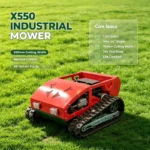
- Xinfa 550 mm remote control lawn mower — the best-selling all-rounder for 0.5-3 acre sloped properties.
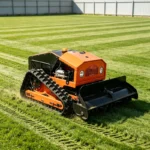
- 550 mm tracked remote control mower — rubber tracks for wet ground and steeper banks.
- 500 mm wheeled remote control mower — the lowest entry price for home hills.
- 800 mm remote control mower — the commercial sweet spot for 3-8 acre jobs.
- 800 mm remote control mower v2 — updated chassis for professional crews.
- 1000 mm tracked remote control mower — maximum slope throughput for farms and municipalities.
Learn how Xinfa builds and supports its machines in our manufacturer profile, and how dealers import them in our import guide.

Commercial Fleets: Pairing Robots and Remote Mowers
Landscaping companies do not have to choose one — the smartest fleets in 2026 run both:
- Robot mowers handle flat, manicured accounts on autopilot, freeing crews for higher-value work.
- Remote control mowers handle the slope accounts — the roadside banks, drainage ditches, and hillside homes that robots cannot touch.
- Crew safety improves because nobody rides a mower on a 30-degree bank.
- Bid capacity expands: teams that own a remote mower can bid hill properties they previously declined.
Our commercial slope mower guide explains the fleet math with real numbers.
Robot Mower vs Remote Control Mower: 5-Year Cost of Ownership
Total ownership cost decides many purchases. Here is a realistic 5-year comparison:
- Robot mower ($2,500 class): purchase $2,500 + boundary wire/accessories $300 + batteries $400 + parts $600 = ~$3,800.
- Xinfa 550 mm remote ($3,500 class): purchase $3,500 + service $800 + fuel/energy $500 = ~$4,800.
- Xinfa 800 mm remote ($5,500 class): purchase $5,500 + service $1,000 + fuel/energy $700 = ~$7,200.
- European remote ($12,000 class): purchase $12,000 + service $1,800 + fuel $1,000 = ~$14,800.
Bar chart: 5-year total cost of ownership (USD)
Robot $2.5k class $3.8k
Xinfa 550mm $4.8k
Xinfa 800mm $7.2k
Euro remote $14.8k
The gap between a premium robot and a factory-direct remote mower is small — and the remote mower cuts slopes the robot cannot. For hilly properties, the remote mower is the better value by a wide margin.
Robot Mower vs Remote Control Mower: Comparison Table
Here is every spec side by side for quick reference:
| Feature | Robot Mower | Remote Control Mower |
|---|---|---|
| Operation | Fully autonomous | Operator-driven (radio) |
| Max slope | 15-25 degrees | 20-45 degrees (tracked) |
| Deck width | 9-14 inches | 20-39 inches (500-1000 mm) |
| Acres per hour | 0.05-0.5 | 0.6-2.5 |
| Terrain | Flat, manicured turf | Slopes, ditches, orchards, rough ground |
| Price range | $800-$4,500 | $2,000-$6,500 (factory direct) |
| Power | Battery only | Gas, battery, or hybrid |
| Boundary system | Wire or GPS required | None — direct control |
| Maintenance | Electronics + blade swaps | Engine/battery + blades + belts |
| Best for | Flat lawns under 1 acre | Hills, banks, orchards, 0.5-10 acres |
Frequently Asked Questions
Which is better for a sloped lawn, a robot mower or a remote control mower?
A remote control mower is better for any slope over about 20 degrees. Robots lose traction on real banks, while tracked remote mowers work to 35-45 degrees with the operator safe on level ground.
Can a robot mower handle a 30-degree slope?
No. Most robot mowers are rated to 15-25 degrees and slip on wet grass well before that. For real banks you need a remote control mower with tracks.
Are remote control mowers faster than robot mowers?
Yes, dramatically. Remote mowers cut 0.6-2.5 acres per hour versus 0.05-0.5 for robots — and they finish in one pass instead of running all week.
Which is cheaper to run over 5 years?
At the same price class, ownership costs are close. Robots add boundary-wire and electronics costs; remote mowers add fuel and blade service. The deciding factor is terrain, not cost.
Can I use both a robot and a remote control mower?
Yes — many owners pair a robot for the flat front lawn with a remote mower for the hills. Our zero turn vs remote control comparison covers the same fleet logic for larger properties.
How far away can I operate a remote control mower?
Xinfa remote mowers work up to 80 meters line-of-sight. Compare ranges in our remote range guide.
Final Verdict
The robot mower vs remote control mower decision is simpler than it looks: flat lawn, small lot → robot. Hills, banks, orchards, or any real terrain → remote control mower.
- Robots win on automation for flat, fenced suburban lawns.
- Remote control mowers win on slopes, throughput, and terrain capability.
- Factory-direct brands like Xinfa make the remote choice affordable — often less than a premium robot with ten times the deck width.
If your property has hills that a rider should not attempt — and CPSC’s injury data says most slopes over 15 degrees qualify — the robot mower vs remote control mower answer is a Xinfa remote mower. Compare the 550 mm wheeled for moderate slopes or the 550 mm tracked for real banks, and you will see why operators keep switching from autonomous robots to direct-controlled power.
Real-World Results: What Owners Report After Switching
Across forums, dealer reviews, and commercial case studies, owners who moved from a robot to a remote control mower report a consistent pattern of results. Here are the outcomes that show up most often:
- Slope acreage that went unmowed now gets cut. Homeowners with a 30-degree side yard previously hired a contractor or let the bank grow wild; a tracked remote mower brings it back under control in an afternoon.
- Mowing time on hills drops 50-70%. Because the remote machine cuts a 20-39 inch swath at walking-to-moderate speed, a 2-acre hilly property that took two days of robot run time becomes a single session.
- Crews stop turning down hill accounts. Landscapers report expanding their service area after adding one remote mower, because the dangerous 20% of every property stops being a liability.
- Boundary-wire headaches disappear. Robot owners who fought wire breaks, GPS drift, and stuck robots describe the transmitter as a relief — no perimeter to maintain, no algorithm to troubleshoot.
- Battery machines bring noise complaints to zero. A battery remote mower cuts at conversation level, so early-morning work in residential areas passes without complaints — something gas riders and some large robots cannot promise.
For the orchard and farm side of the story, read our remote mower orchard guide; for the commercial contractor angle, see our commercial slope mower guide.
5 Mistakes When Choosing Between Robot and Remote Mowers
Buyers waste money on the robot mower vs remote control mower decision in predictable ways. Avoid these five:
- Buying a robot for a property with real slopes. A robot rated for 20 degrees will not cut your 30-degree bank, no matter how expensive it is.
- Ignoring deck width. A 10-inch robot deck on a 1-acre lawn means days of run time; a 550 mm remote mower finishes in hours.
- Choosing by price alone. The cheapest option in either category usually lacks slope rating, parts support, or both.
- Forgetting the operator. If you actually want to watch the machine work and control the passes — common on hills — a robot’s autonomy becomes a frustration, not a feature.
- Buying a middleman brand. Factory-direct manufacturers like Xinfa publish specs and support dealers; resellers often cannot supply spare parts two years later.
Our cost guide and factory-direct buying guide cover the money side of these mistakes in detail.
Robot Mower vs Remote Control Mower: How to Test Before You Buy
Both machines are expensive enough to deserve a demo. Here is a practical test plan:
- Ask the dealer or factory for a slope demo on terrain close to yours — not a flat parking lot.
- Run the robot for one full cycle on your boundary; watch how it handles the edges and any wet spots.
- Drive the remote mower up your steepest bank; check traction, turning, and the transmitter’s response at distance.
- Compare cut quality on tall grass and uneven ground — robots mow frequently so they never face tall grass; remote mowers must handle it.
- Check parts and service response: ask how fast you can get blades, belts, and electronics.
If you cannot demo locally, ask for video proof of the machine on a slope comparable to yours, plus a spec sheet with slope ratings in degrees.
Robot Mower vs Remote Control Mower: The Bottom Line
Here is the honest summary of the robot mower vs remote control mower comparison in 2026:
- Robot mowers are convenience devices for flat lawns. They automate a simple job beautifully, and the market data shows explosive growth — but their physical limits (slope, terrain, deck width) are hard ceilings.
- Remote control mowers are work machines for real properties. They trade full autonomy for direct control, and in exchange they deliver 10x deck width, real slope capability, and one-session completion.
- Xinfa closes the price gap: a factory-direct remote mower costs the same as a premium robot while out-working it on any property with a hill.
If your land is flat and small, enjoy the robot — it is the right tool. If your land has hills, banks, orchards, or any terrain a rider should not attempt, the robot mower vs remote control mower question already has its answer: buy a remote control mower. Start with Xinfa’s best-selling 550 mm model or the 550 mm tracked for real slopes, and you will understand the difference the first time you cut a bank without riding it.